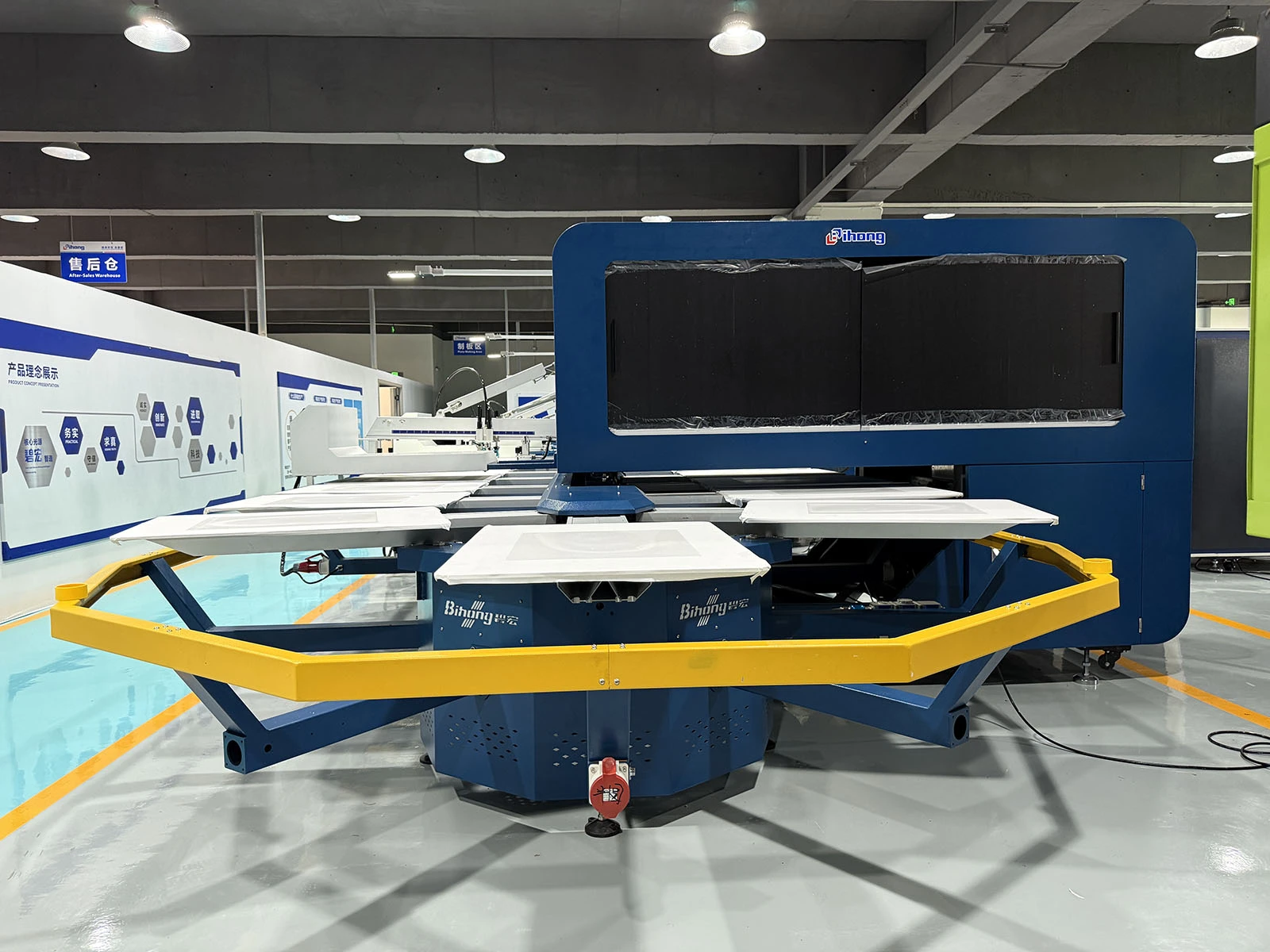


The implementation of digital inkjet printing technology relies on specific hardware and associated consumables, primarily including digital printing machines, core printing components, specialized inks, and auxiliary systems.
Core Equipment
The central piece of equipment is the digital printing machine itself. Based on printhead technology and application scenarios, these machines fall into three main categories: first, flatbed printers modified from Epson desktop models (e.g., the modified Epson T50), primarily used for small-format printing with pigment inks; second, printers equipped with Epson DX4/DX5/DX6/DX7 series inkjet printheads (e.g., Mimaki JV3-160, Mutoh 1604); and third, high-speed industrial digital printers utilizing industrial-grade printheads from manufacturers such as Kyocera, Seiko SPT, Konica, and Spectra-equipment that generally entails higher purchase and operating costs. A representative domestic enterprise is Hangzhou Honghua Digital Technology Co., Ltd.; its direct-to-fabric printers achieve a printing resolution of 1200 dpi and speeds of up to 1,000 m²/hour. "Single-pass" (one-step) and "double-pass" (two-step) configurations represent the two primary structural designs for double-sided digital printing machines.
Key Components
The inkjet printhead is the core component of the digital printer; its performance directly determines printing precision and speed. Piezoelectric printheads are currently the mainstream choice. Printheads are expensive and constitute a major portion of the equipment's cost. They require regular maintenance: minor clogs can be cleared using the machine's built-in ink-suction cleaning function, while severe clogs require soaking and cleaning. Anti-static precautions are essential during printhead installation, and the use of high-quality original inks helps extend the printhead's lifespan.
Main Consumables
Digital printing ink is a critical consumable, categorized primarily into dye-based and pigment-based inks. Dye-based inks include acid, reactive, and disperse inks, while pigment-based inks consist mainly of textile pigment inks. Inks must be precisely matched to both the fabric type and the printhead. The development of white ink remains a technical challenge; reliance on imports for this component has constrained printing applications on dark-colored fabrics. Domestic enterprises such as Zhengzhou Hongsheng Digital Technology Co., Ltd. and Sense Nano are also developing high-quality inks; Sense Nano has achieved manufacturing technology for 50-nanometer water-based inkjet particles, thereby improving printing fluidity.
Auxiliary Systems
A complete digital printing system also incorporates several auxiliary systems to ensure stable operation. The ink supply system provides a continuous, steady flow of ink over extended periods, eliminating the need for frequent cartridge replacements. The conveyor belt system keeps the fabric flat and prevents shifting during the printing process. The drying system is used to rapidly cure the ink; high-speed equipment often integrates the drying unit directly into the production line. Additionally, the setup includes supporting equipment for processes such as pre-treatment sizing and post-treatment steaming and washing.